
Late at night, a man types into a prompt box: “An overgrown wooden porch at dusk, wisteria hanging from the rafters, warm light from the kitchen window, watercolor.” He never held a brush, didn’t learn to draw. The families house burned down thirty years ago. His grandmother lived there. Seconds later, the screen blooms with four golden-hued images. He stares at them with tears in his eyes. For the first time ever, he can show his daughter where his memories live. But beneath that quiet miracle lies an uncomfortable truth: every wash of color, shadow, and wood grain was mined from the digitized life’s work of thousands of painters who never consented to be his ghost illustrators.
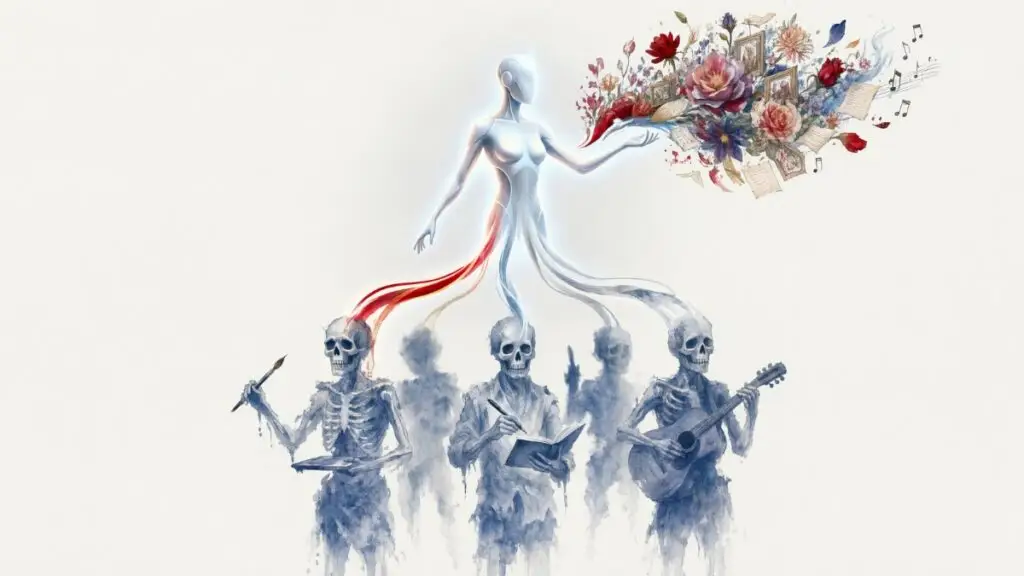
In my opinion the defining tragedy of generative AI is that its gift of democratization is inherently inseparable from the historic theft of human craft. Therefore, I call it a parasitic renaissance of generative AI. Like the renaissance, it is a time where we can see a lot of creative work, due to the removal of the time-gated skill acquisition process aka learning the craft. But none of it is possible without the parasitic extraction of the work of generations of artists and thinkers before us. A classic dilemma where both sides of the coin have merit, but each side wants to sacrifice the other.
For the sake of clarity, I’ll use image generation and painting in this text, but the same principle goes for writing, music and basically every other art form or craft that can be replicated with artificial intelligence.
Why democratization in art through AI matters
Art has historically worked as a mirror of society. It gave us a glimpse into the mind or soul of an artist. The collective body of art showed us the state of humanity. Previously the abilities to show others what’s on your mind was only available to those who had access to teachers of the craft and the time and discipline to hone it. Throughout history this could be classified as time or class privilege.
Having an artistic vision meant nothing unless you invested thousands of hours mastering anatomy, perspective, draftsmanship, color theory, or later, software. Craft acted as an involuntary gatekeeper.
When this barrier falls, it gives us a higher-resolution image of the status quo. More people will be able to materialize what’s in their mind. We gain a richer, potentially more diverse perception of how we humans see the world.
We will see or hear stories, that would otherwise have been locked away. In my opinion, that is a desirable outcome.
An unprecedented plunder of our artistic lineage
Artists critique that their work was stolen to feed the machine. That is an undeniable fact. Legal courts around the world are trying to figure out how to handle this. Living artists are forced to compete with machine output, that is based on their work, skill and time. They never agreed and never saw compensation or appreciation. Even if we think legal courts will settle this, it’s unlikely that notable money will find its way to all the artists that are victims of this AI theft.
We also sacrifice culture. Traditionally any craft was passed down in creative lineages over generations. Teachers, students, apprenticeships, struggle and time invested. An artists style depended on those who came before him and who walked besides him. The masters who taught and the peers who walked the way together.
With the emergence of generative AI, this lineages are broken. Everything becomes averaged out. This might give birth to new lineages of generative AI users, who follow in similar traditions, but they start at zero.
Living inside the dilemma of the parasitic renaissance
The democratization of art in the hands of amateurs, via generative AI, relies on the economic death of the artisan. AI decouples the vision from the execution. It dignifies the inner world of non-specialists by letting them materialize their thoughts by writing a prompt that simply explains what they envision. In doing so, it treats centuries of human discipline and physical sacrifice as a solved mathematical problem instead of an act of lived endurance.
If everyone can create art that is “good enough,” many artists will not be able to earn a living anymore. A small fracture of artists will be. Those who stand out among the others and their art will become even more valuable, but only for those who can see the difference and are willing to pay the premium price. Most other illustrations will be done by AI, because it will be “good enough” and most humans won’t notice it’s AI soon.
Interestingly, artists, including myself, are not worried if they use generative AI to tackle tasks that don’t produce art. But the underlying machine, runs on the same mechanics. It pulls from the work of humans before it. We just don’t care about it, if it is not our work, or we don’t like the work at all. Thinking it through until the end, would lead to the exact same dilemma on another playing-field. It does your accounting but someone else could do it, who spent the time to learn it. It’s just not art.
But is it fair, that we don’t care? We defend our own work against the machine, but not the work of others. Those others also learned their craft, and some of them might love their jobs, as much as we love being artists – even if most of us find it hard to get behind the idea of loving to be an accountant or a physical worker in hazardous environment. If we abstract the idea of what happens with genAi and art, it is exactly the same as AI taking any other job.
Beyond denial
Silicon Valley just wants to wave AI through and wants artists to adapt to and adopt the new ways. Traditional artists and many others want to outright ban all AI, because they are afraid of losing jobs and possible Terminator scenarios. In between are tech-enthusiasts who are excited to live through a major change in human history, entrepreneurs who see this fourth industrial revolution as their once-in-a-lifetime opportunity, culture workers who automate costly tasks that would have prevented projects from happening, and many others who use AI in their daily lifes.
There is no objectively correct answer on how to navigate this dilemma, and there is no real middle-ground. Being fine with AI doing some work, as long as it not ours, is hypocrisy. Thinking we can put it back in a box, is naive.
There might be solutions in the future, like models that are exclusively trained on data where everyone approved. There could be new tech that allows us to track what data was used for a generation and pay compensation. But right now, we have very little of the first and we don’t have the second. And over all, the tech was still built using data that was stolen, even if we fix it later.
So the parasitic renaissance dilemma will be a topic for the years to come. Anyone who uses generative AI tools must develop the moral honesty to acknowledge both sides: celebrating the voice they have gained, while grieving the cultural debt they will likely never repay.