art meets tech

Articles from FraGue Moser-Kindler about topics that bridge art and technology. You’ll find texts about AI, conventional software and hardware, as well as thoughts about technology changing how we approach art.

The skills of a whole lineage of artists are placed into the hands of laymen, via AI.

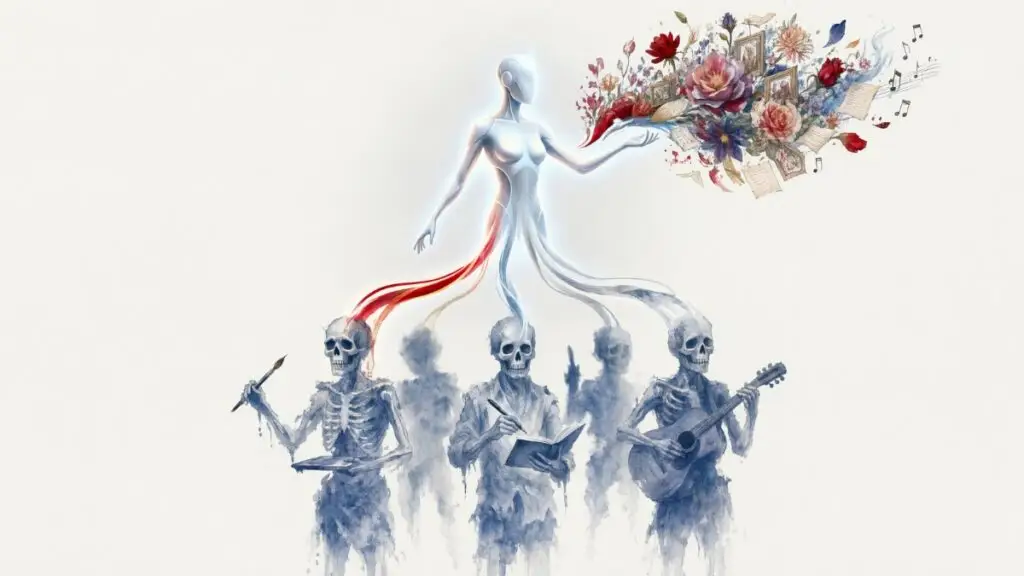
The Parasitic Renaissance: how generative AI democratizes art through theft

Late at night, a man types into a prompt box: “An overgrown wooden porch at dusk, wisteria hanging from the rafters, warm light from the kitchen window, watercolor.” He never held a brush, didn’t learn to draw. The families house burned down thirty years ago. His grandmother lived there. Seconds later, the screen blooms with four golden-hued images. He stares at them with tears in his eyes. For the first time ever, he can show his daughter where his memories live. But beneath that quiet miracle lies an uncomfortable truth: every wash of color, shadow, and wood grain was mined from the digitized life’s work of thousands of painters who never consented to be his ghost illustrators.

In my opinion the defining tragedy of generative AI is that its gift of democratization is inherently inseparable from the historic theft of human craft. Therefore, I call it a parasitic renaissance of generative AI. Like the renaissance, it is a time where we can see a lot of creative work, due to the removal of the time-gated skill acquisition process aka learning the craft. But none of it is possible without the parasitic extraction of the work of generations of artists and thinkers before us. A classic dilemma where both sides of the coin have merit, but each side wants to sacrifice the other.

For the sake of clarity, I’ll use image generation and painting in this text, but the same principle goes for writing, music and basically every other art form or craft that can be replicated with artificial intelligence.

Why democratization in art through AI matters

Art has historically worked as a mirror of society. It gave us a glimpse into the mind or soul of an artist. The collective body of art showed us the state of humanity. Previously the abilities to show others what’s on your mind was only available to those who had access to teachers of the craft and the time and discipline to hone it. Throughout history this could be classified as time or class privilege.

Having an artistic vision meant nothing unless you invested thousands of hours mastering anatomy, perspective, draftsmanship, color theory, or later, software. Craft acted as an involuntary gatekeeper.

When this barrier falls, it gives us a higher-resolution image of the status quo. More people will be able to materialize what’s in their mind. We gain a richer, potentially more diverse perception of how we humans see the world.

We will see or hear stories, that would otherwise have been locked away. In my opinion, that is a desirable outcome.

An unprecedented plunder of our artistic lineage

Artists critique that their work was stolen to feed the machine. That is an undeniable fact. Legal courts around the world are trying to figure out how to handle this. Living artists are forced to compete with machine output, that is based on their work, skill and time. They never agreed and never saw compensation or appreciation. Even if we think legal courts will settle this, it’s unlikely that notable money will find its way to all the artists that are victims of this AI theft.

We also sacrifice culture. Traditionally any craft was passed down in creative lineages over generations. Teachers, students, apprenticeships, struggle and time invested. An artists style depended on those who came before him and who walked besides him. The masters who taught and the peers who walked the way together.

With the emergence of generative AI, this lineages are broken. Everything becomes averaged out. This might give birth to new lineages of generative AI users, who follow in similar traditions, but they start at zero.

Living inside the dilemma of the parasitic renaissance

The democratization of art in the hands of amateurs, via generative AI, relies on the economic death of the artisan. AI decouples the vision from the execution. It dignifies the inner world of non-specialists by letting them materialize their thoughts by writing a prompt that simply explains what they envision. In doing so, it treats centuries of human discipline and physical sacrifice as a solved mathematical problem instead of an act of lived endurance.

If everyone can create art that is “good enough,” many artists will not be able to earn a living anymore. A small fracture of artists will be. Those who stand out among the others and their art will become even more valuable, but only for those who can see the difference and are willing to pay the premium price. Most other illustrations will be done by AI, because it will be “good enough” and most humans won’t notice it’s AI soon.

Interestingly, artists, including myself, are not worried if they use generative AI to tackle tasks that don’t produce art. But the underlying machine, runs on the same mechanics. It pulls from the work of humans before it. We just don’t care about it, if it is not our work, or we don’t like the work at all. Thinking it through until the end, would lead to the exact same dilemma on another playing-field. It does your accounting but someone else could do it, who spent the time to learn it. It’s just not art.

But is it fair, that we don’t care? We defend our own work against the machine, but not the work of others. Those others also learned their craft, and some of them might love their jobs, as much as we love being artists – even if most of us find it hard to get behind the idea of loving to be an accountant or a physical worker in hazardous environment. If we abstract the idea of what happens with genAi and art, it is exactly the same as AI taking any other job.

Beyond denial

Silicon Valley just wants to wave AI through and wants artists to adapt to and adopt the new ways. Traditional artists and many others want to outright ban all AI, because they are afraid of losing jobs and possible Terminator scenarios. In between are tech-enthusiasts who are excited to live through a major change in human history, entrepreneurs who see this fourth industrial revolution as their once-in-a-lifetime opportunity, culture workers who automate costly tasks that would have prevented projects from happening, and many others who use AI in their daily lifes.

There is no objectively correct answer on how to navigate this dilemma, and there is no real middle-ground. Being fine with AI doing some work, as long as it not ours, is hypocrisy. Thinking we can put it back in a box, is naive.

There might be solutions in the future, like models that are exclusively trained on data where everyone approved. There could be new tech that allows us to track what data was used for a generation and pay compensation. But right now, we have very little of the first and we don’t have the second. And over all, the tech was still built using data that was stolen, even if we fix it later.

So the parasitic renaissance dilemma will be a topic for the years to come. Anyone who uses generative AI tools must develop the moral honesty to acknowledge both sides: celebrating the voice they have gained, while grieving the cultural debt they will likely never repay.

The Parasitic Renaissance: how generative AI democratizes art through theft Read More »

An AI avatar built from lights and code. Created by Nano Banana

Navigating the AI Revolution in Art and Culture

The relationship between technology and creativity has always been “dynamic”. Think about the shift from creating music with instruments and recording them versus being able to produce complete pieces only with your laptop. Now, the rise of Artificial Intelligence (AI) will be an even bigger change.

Generative AI is not a futuristic concept. It is an active collaborator and competitor within the cultural landscape. It challenges the status quo, how art has been made. And it might take the jobs of many who are “just doing their job.”

The Current State of Generative AI

The current boom in AI art is defined by rapidly evolving tools. Text-to-Image models like Midjourney and DALL-E, advanced language models such as ChatGPT or Grok, and powerful music and video generators are making creation faster then ever. These tools have drastically lowered the barrier to entry for creative output.

A user with a simple text prompt can generate complex visual concepts, musical scores, or narrative outlines in seconds. This accessibility democratizes creation, allowing users who lack traditional skills (like painting, writing or filmmaking) to execute ideas at an unprecedented speed.

AI: Creator, Co-Pilot, and Cultural Catalyst

The possibilities AI offers in culture and arts are best understood through a dual lens: creation and administration.

AI for Creation

AI could serve as a powerful partner. For an artist, it can be used for rapid prototyping, instantly generating variations of a concept, breaking through creative blocks, or pushing the boundaries of traditional media into new forms of interactive and personalized art. AI can turn a simple sketch into a detailed rendering, or translate a mood into a musical composition, focusing the human creator’s time on curation and direction rather than tedious execution.

But exactly in this advantage is also the big problem. Many who did not learn any skills in the arts are now able to participate in a game that was only for those who “earned their stripes” in thousands of hours of practice.

Connoisseurs still recognize AI art as machine-made, but the current speed of development suggests it’s only a matter of a few years, or maybe months, until it will be indistinguishable to all of us. The big bunch of people don’t see the difference now, and many more don’t care. This creates a potential imbalance in compensation for time invested.

AI for Logistics (The ‘Orga’)

AI’s role also extends far beyond the studio and into the operational core of cultural institutions. Here, it acts as a catalyst for efficiency. It can help with grant writing, with texting and illustrating concepts, ads and other sales material.

It finds holes in your workflow, acts as your accountant, does research, and can speed up processes. Especially this way of using AI for the orga in your artistic ventures gives a lot of power back to the artists, as they would now be able to do tasks themselves, which usually required a producer. It removes gatekeeping and makes producing art more affordable for the artist.

While using AI for creation is currently frowned upon, using AI to support in the orga is a thing people appreciate. But if we think things through, it is doing the same to producers and assistants as it does to artists in the other case. So, celebrating one of those two and condemning the other would be a double standard.

The Ethics of Creation: Ownership and the Authenticity Crisis

The rapid adoption of AI is accompanied by significant moral and legal concerns that must be addressed and understood by artists and institutions alike.

Ownership and Copyright

The most contentious issue involves the training data. Generative AI models are trained on massive amounts of data. Billions of copyrighted images, texts, or songs have been fed into the machine, most of the time without the explicit consent or compensation of the original human creators. This raises fundamental questions of intellectual property and is copyright infringement on a massive scale.

When an AI creates a piece, who owns it: the original artists whose work was scraped, the company that built the model, or the user who supplied the prompt? Current legal frameworks are struggling with this question. In most countries, the law gravitates towards “when something is created by AI, you can monetize it, but you don’t have a copyright.” Means everyone could steal what the AI created, because it’s nobody’s intellectual property.

An interesting story from a US Copyright Office shows how this could end up in reality. A creator got copyright on a print and digital comic because the copyright office deemed the arrangement of the comic, which was done by a human, as enough to say: “this is a new work, defined by the human’s involvement.” Important to note, only the comic in its entirety has a copyright. The single graphics that are generated by AI, can still be used by everyone and are not protected.

The laws around this will change quickly, and it will definitely be a pain in the ass to stay up to date.

The Crisis of Authenticity

The ease and speed of AI output also generate an authenticity crisis. If an AI can create a complex, technically proficient painting in under a minute, does the work still hold the same cultural value as a piece created over months of human labor, struggle, and learned skill? Many, including me, feel the essence of art lies in the effort and the human intent, which AI currently bypasses, leading to a devaluing of traditional artistic expertise.

That’s the point we discussed already. Art lovers and people who are skilled in the arts can see the difference and despise work created by AI. For good reasons. Studio Ghibli Founder Hayao Miyazaki called AI-created graphics an “Insult To Life Itself,” after millions of AI-generated images, in the signature style of his studio, showed up all over social media.

AI will take our jobs

The threat of AI taking jobs is real. Especially jobs that are basically doing the same thing over and over. Mundane intellectual labor is the first thing that will be replaced by AI. Most creative jobs will be among these. Top players within their respective fields will have no problem, as they are paid for their taste and style of doing things in a specific way.

But the average person’s work can and will be replaced by AI, as it is more consistent and will soon be cheaper. Physical jobs (everything that is not in the office) will be viable for a few more years, until robots can be mass-produced cheaply at scale.

What do we make of it?

AI is here to stay. Thinking about it differently is naive. Too many global players with too much money are currently racing towards the improvement of their AI systems and they are already integrated everywhere.

It’s time for everyone to think about how we’ll handle AI. You can ignore, you can hate it, or you can learn to dance with it. There will be bubbles that are AI-free, but the majority of life will integrate AI, whether we like it or not. The real challenge is not to reject the technology, but to define its role in your workflow and find ways to improve your art, without taking away its soul.

I don’t have good answers on how to do that, yet. I recommend to learn how the machine works, and then judging if you can use it to improve what you do. Maybe you can use it to tell a story that you couldn’t tell without it.

And maybe we should learn how to build an EMP. 😇

Navigating the AI Revolution in Art and Culture Read More »

A laptop with glowing matrix code on the screen.

NFTs and Art: A New Era of Distribution and Trading

Selling and distributing art has always been a pain in the ass, but blockchain offers a potential solution with NFTs – which stands for Non-Fungible Tokens. Imagine being able to sell your piece of work, which can be everything that you can bring into the digital space, immediately and worldwide with 100% proof of who created it, who bought and therefore owns it, and built-in mechanics to collect royalties if it is resold. That is the concept behind NFTs.

Navigating the Old School Art Scene

Let’s be real. Selling and getting your art out there in the traditional art world is like navigating a maze blindfolded. Galleries and auction houses act like they own the joint, picking and choosing whose art gets to see the light of day. This means a whole bunch of seriously talented artists get left in the dust, struggling to get their work in front of the people who might actually want to buy it.

And don’t get me started on pricing. It’s about as clear as mud. The price tag on a piece of art has more to do with who you know, what some critic said on a Tuesday, or which way the wind is blowing, rather than the actual quality of the work. Plus, when your art does sell, you’re lucky if you see half the dough. The rest of it goes to the middlemen, and if your work gets resold for a higher price later, do you see any of that sweet profit? Nope, nada.

Now, let’s not forget about the headache that is managing physical art. You’ve got to sort out storage, deal with the nightmare of transporting it without damaging it, and fork out for insurance just in case. And the kicker? Your work can only be seen by people who stroll into the gallery or exhibition it’s in. But here’s the thing. We’re living in the digital age, folks. Shouldn’t there be a better way to sell and share our art? That’s where NFTs, or Non-Fungible Tokens, come in. They might just be the game-changer in the art world we’ve all been waiting for.

The New Kid on the Block(chain)

Imagine this: You take your art, whatever that might be – a painting, a doodle, a digital masterpiece – and you create a digital token for it. This token, my friends, is an NFT, a Non-Fungible Token. It’s unique, it’s special, it’s like a digital certificate of authenticity that says, “Hey, this piece of art? It’s one-of-a-kind, and it’s all yours.”

So, you’ve got your NFT art, and here’s where the blockchain comes in. The blockchain is like a secure digital ledger, keeping track of all the ins and outs of your NFT art. It’s permanent, it’s transparent, and it’s tamper-proof. That means when you sell your NFT art, there’s a permanent record of that sale – who sold it, who bought it, and for how much. It’s like a digital paper trail that can’t be fudged.

With NFT art, you’re not just selling your work to the highest bidder. You’re also setting up a way to keep earning every time your art changes hands. Remember when I said you don’t see a dime when your art gets resold in the traditional art world? Well, with NFT art, you can set it up to get a cut every time your art gets resold. Talk about a revolution! NFTs and blockchain are not just changing the game; they might be able to flip the whole darn art table.

Getting Your Feet Wet in the NFT Art Pond

Diving into the NFT art space isn’t all sunshine and rainbows. At least, not yet. It’s a bit like learning to swim in the deep end. There are a few things you need to watch out for.

First up, the tech stuff. If you’re not a bit of a tech whizz, the whole process of creating NFT art can be a bit daunting. You’ve got to get your head around things like crypto-wallets, gas fees, and minting tokens. And if those words sound like a foreign language, you’re not alone. But don’t fret. With a bit of patience, a healthy dose of curiosity, and maybe a YouTube tutorial or two, you can get the hang of it.

Then there’s the rollercoaster ride that is the world of cryptocurrency. One minute you’re on top of the world; the next you’re in the pits. That’s because the value of cryptocurrencies like Ethereum or Cardano can shoot up and down faster than a yo-yo. So, if you’re not up for a bit of a thrill ride, this might not be the space for you.

Stepping into the world of NFT art is a bit like embarking on a wild adventure. There might be a few bumps in the road, but it can be exciting.

I suggest you get on-board immediately, but I understand if you want to watch the space first. Just don’t sleep on it and miss a potential opportunity that could unleash your work. Early adopters are always the ones who profit most when “their” tech goes mainstream.

If you want to read up on how to turn you art into an nft, check out the projects below.

  • NMKR.io is a platform that allows you to mint and sell NFTs on the Cardano Blockchain.
  • Opensea is one of the biggest marketplaces on Ethereum
  • LooksRare is one of it’s main competitors
  • jpg.store is an amazing marketplace on Cardano

The success-story of Beeple

Beeple has become a significant figurehead in the NFT world, having sold his digital art piece “Everydays: The First 5000 Days” at Christie’s auction house for a staggering $69 million in March 2021. This sale not only propelled Beeple into the spotlight but also accentuated the potential of NFTs as a revolutionary tool for artists. With blockchain’s authentication and royalty mechanism, artists could now reap the benefits of their work’s resale, disrupting traditional art market dynamics.

Beeple’s monumental success has also highlighted the democratizing aspect of NFTs in the art world. Unlike the usual high-end art auctions catering primarily to the upper echelons, the NFT market invites participation from anyone with an internet connection and some cryptocurrency. This innovative approach offers a new platform for artists and collectors alike, expanding the boundaries of the art market.

The Future of NFT Art

As we continue to witness the digital revolution unfold, one of the most intriguing developments in the art world is the rise of Non-Fungible Tokens (NFTs). These digital assets are transforming the way art is created, distributed, and traded, harnessing the power of blockchain technology to bring about a new era of art appreciation and ownership. NFTs provide a digital certificate of ownership that can be bought and sold, with the blockchain forever showing the original creator. This is a significant evolution from traditional art markets and one that could potentially revolutionize the industry.

Currently, NFTs are slowly drifting into the mainstream, and everyone who gets on board now can be considered an early adopter. At the moment, NFTs are priced and bought in cryptocurrency, which is likely to remain the status quo for a while. However, with the rising popularity of NFTs, there will likely be more apps and service providers that will make it easier for everyone to enter the NFT space​.

Moreover, a plethora of NFT creator software has emerged, catering to different needs and skill levels. For instance, GoArt enables the conversion of images into realistic artistic works and efficiently mints NFTs. PixelChain is an NFT creator software that stores information and metadata efficiently in the chain, ensuring that the data is always accessible. Nifty Ink is a platform that allows artists to create, sell, and earn tokens without learning blockchain techniques. Other notable software includes Fotor, NightCafe, VoxEdit, and Hotpot.ai, each offering unique features to aid artists in their NFT creation journey​2​.

NFT Trends and Implications for Artists

As for the future trends in the NFT art space, it’s important to note that the landscape is rapidly evolving and can be influenced by various factors such as technological advancements, market demand, and legal regulations. While I was unable to find specific future trends due to time constraints, I can infer a few potential trends based on the current state of the NFT art market.

  1. Increased accessibility and ease of use: As the technology matures, the process of creating and trading NFTs is likely to become more user-friendly, attracting more artists and collectors to the space.
  2. More diversified use of NFTs: While NFTs are currently popular in the art world, they could be used for a wide range of digital assets, including music, virtual real estate, and digital collectibles.
  3. Integration with other technologies: We might see more integration of NFTs with other emerging technologies such as virtual and augmented reality, which could create new ways for artists to showcase their work and for audiences to experience it.
  4. More regulatory clarity: As the NFT market grows, it’s likely that more regulations will be put in place to address issues such as copyright infringement and fraud, which could impact how artists create and sell NFT art.

While NFTs provide exciting opportunities for artists, they also come with potential risks and challenges. These include price volatility, security concerns and the environmental impact of blockchain technology. Therefore, artists should carefully consider these factors before diving into the NFT art world.

Will you be brave and early as one of the early adopters, or do you prefer to watch and see how it goes before you jump on the train?

NFTs and Art: A New Era of Distribution and Trading Read More »